
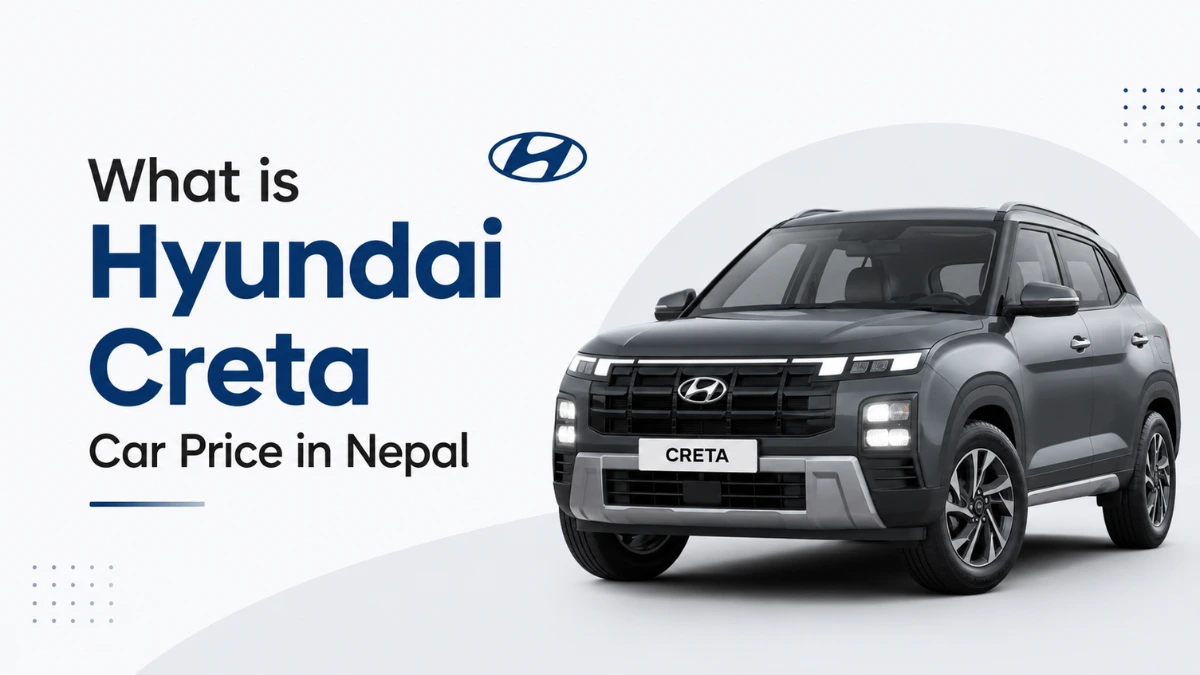
The Hyundai Creta price in Nepal starts at Rs. 54.56 lakh for the base E variant and rises to Rs. 76.96 lakh for the top SX CVT, ex-showroom. The Creta Electric starts lower still, at Rs. 51.96 lakh. Add registration, first-year insurance and road tax, and the real on-road price lands roughly 4% above the showroom figure.
That 4% surprises people, because everyone walks into a Nepali showroom braced for a second bill that never quite arrives. The government already took its cut before the car reached the floor. By the time you get to the transport office, the state has moved on to the next person.
The genuinely expensive part is not the paperwork. It is the petrol.
This guide covers every Creta variant sold in Nepal, the full on-road cost of each one, what you can actually borrow under Nepal Rastra Bank’s rules, road tax in all seven provinces, real resale asking prices from Kathmandu dealers, and a five-year cost comparison between the petrol and electric versions that produced a result even we had to check twice.
Want to purchase the Car price in Nepal under 30 lakh
Table of Contents
Hyundai Creta Price in Nepal 2026 — Full Variant List
The Creta is sold in Nepal in five petrol variants and one electric version. Prices below are ex-showroom.
Petrol varaint
| Variant | Engine | Transmission | Ex-showroom Price | Est. On-road Price |
|---|---|---|---|---|
| Creta E | 1497 cc petrol | 6-speed manual | Rs. 54.56 lakh | Rs. 56.74 lakh |
| Creta S | 1497 cc petrol | 6-speed manual | Rs. 62.56 lakh | Rs. 64.94 lakh |
| Creta S+ | 1497 cc petrol | 6-speed manual | Rs. 65.96 lakh | Rs. 68.43 lakh |
| Creta SX | 1497 cc petrol | 6-speed manual | Rs. 70.56 lakh | Rs. 73.14 lakh |
| Creta SX CVT | 1497 cc petrol | CVT automatic | Rs. 76.96 lakh | Rs. 79.70 lakh |
Electric variant
| Variant | Battery | Range (claimed) | Ex-showroom Price | Est. On-road Price |
|---|---|---|---|---|
| Creta Electric | 42 kWh | 390 km | Rs. 51.96 lakh | Rs. 53.98 lakh |
Reading the price ladder
The jump from E to S costs Rs. 8 lakh and is the biggest single step in the range. It is also the only one where the money buys a transformation rather than a garnish.
After that the maths gets less generous. Rs. 3.4 lakh from S to S+. Rs. 4.6 lakh from S+ to SX. Then Rs. 6.4 lakh from SX to SX CVT, which buys precisely one thing: a gearbox that shifts itself.
And then there is the electric Creta, which undercuts every petrol variant including the base one. In most countries the EV carries a premium you spend five years paying off. In Nepal it is the cheapest way into the model. Nepal’s tax policy has produced a car that is cheaper to buy and cheaper to run, which is the sort of thing that usually only happens in advertisements.
What Is the On-Road Price of the Hyundai Creta in Nepal?
The on-road price of the base Creta E in Nepal is approximately Rs. 56.74 lakh about Rs. 2.18 lakh, or 4%, above the ex-showroom price of Rs. 54.56 lakh. That covers registration, the number plate, first-year road tax, the renewal charge, comprehensive insurance and a basic accessory package.
Full breakdown for the Creta E, registered in Bagmati Province:
| Cost item | Amount | Notes |
|---|---|---|
| Ex-showroom price | Rs. 54,56,000 | What the dealer quotes |
| Registration and bluebook | Rs. 3,000 | One-time |
| Embossed number plate | Rs. 3,500 | One-time |
| Road tax, first year | Rs. 25,000 | 1,001–1,500 cc slab, Bagmati |
| Renewal charge | Rs. 500 | Annual, four-wheeler |
| Comprehensive insurance | Rs. 1,36,400 | Estimated at 2.5% of vehicle value |
| Accessories and fitting | Rs. 50,000 | Mats, covers, camera, tint |
| Total on-road | Rs. 56,74,400 | Rs. 56.74 lakh |
Look at where the money actually goes. Registration and the number plate together come to Rs. 6,500 on a Rs. 54 lakh car, that is roughly the cost of two tanks of petrol. Road tax is Rs. 25,000.
Insurance is Rs. 1.36 lakh. It is, by a distance, the largest thing added after the showroom price, and it is the only line on that list you have any real control over.
On-road price, every variant
| Variant | Ex-showroom | Road tax | Insurance | Total on-road | Extra over showroom |
|---|---|---|---|---|---|
| Creta E | Rs. 54.56 L | Rs. 25,000 | Rs. 1,36,400 | Rs. 56.74 L | Rs. 2.18 L (4.0%) |
| Creta S | Rs. 62.56 L | Rs. 25,000 | Rs. 1,56,400 | Rs. 64.94 L | Rs. 2.38 L (3.8%) |
| Creta S+ | Rs. 65.96 L | Rs. 25,000 | Rs. 1,64,900 | Rs. 68.43 L | Rs. 2.47 L (3.7%) |
| Creta SX | Rs. 70.56 L | Rs. 25,000 | Rs. 1,76,400 | Rs. 73.14 L | Rs. 2.58 L (3.7%) |
| Creta SX CVT | Rs. 76.96 L | Rs. 25,000 | Rs. 1,92,400 | Rs. 79.70 L | Rs. 2.74 L (3.6%) |
| Creta Electric | Rs. 51.96 L | Rs. 15,000 | Rs. 1,29,900 | Rs. 53.98 L | Rs. 2.02 L (3.9%) |
Assumes Bagmati registration, comprehensive insurance, Rs. 50,000 accessory package.
The three lines that can move
Insurance. Comprehensive cover runs 2–3% of vehicle value in year one. Third-party-only costs around Rs. 11,000, which sounds wonderful right up until someone reverses into you and you discover third-party cover pays for their car with the enthusiasm of a stranger and yours with nothing at all. Your bank will insist on comprehensive anyway if you are financing.
Accessories. Rs. 50,000 is a middling package. The showroom will offer you a bundle containing seat covers, floor mats, a reverse camera, sun film, and a small bottle of something described as “premium ceramic protection.” Nothing in that bundle is compulsory. The mats are genuinely useful. The bottle is optional in every sense of the word.
Dealer discounts. Cash discounts, exchange bonuses and corporate schemes exist, and they are rarely volunteered. Ask directly. Ask again in Ashad, when dealers are chasing annual targets and suddenly become extremely reasonable people.
Hyundai Creta Road Tax in Nepal — All Seven Provinces
Road tax on a 1,497 cc Creta is Rs. 25,000 a year in Bagmati Province, plus a Rs. 500 renewal charge. Outside Bagmati it is lower typically 8–12% less in Gandaki and Lumbini, and less again in Koshi, Karnali and Sudurpashchim.
Since federalisation, road tax has been a provincial subject. Each of the seven provinces passes its own Economic Bill and sets its own slabs. Bagmati, which contains Kathmandu, consistently charges the most — a fact Kathmandu residents may file alongside the traffic and the air quality.
Bagmati Province slabs (published)
Private petrol and diesel cars, taxed by engine displacement:
| Engine size | Annual tax |
|---|---|
| Up to 1,000 cc | Rs. 22,000 |
| 1,001–1,500 cc | Rs. 25,000 |
| 1,501–2,000 cc | Rs. 27,000 |
| 2,001–2,500 cc | Rs. 37,000 |
| 2,501–3,000 cc | Rs. 50,000 |
| 3,001–3,500 cc | Rs. 65,000 |
| Above 3,500 cc | Rs. 70,000 |
The Creta’s 1,497 cc engine sits three cubic centimetres below the Rs. 27,000 band. Three cc. Somewhere in Hyundai’s engineering department this was almost certainly deliberate, and it saves you Rs. 2,000 every year for as long as you own the car.
Private electric cars, taxed by peak motor power:
| Motor output | Annual tax |
|---|---|
| Up to 50 kW | Rs. 6,500 |
| 51–125 kW | Rs. 15,000 |
| 126–200 kW | Rs. 20,000 |
| Above 200 kW | Rs. 30,000 |
The up-to-50 kW slab rose from Rs. 5,000 to Rs. 6,500 in the latest bill. Everything above 50 kW stayed put, and petrol rates did not move at all.
The other six provinces
| Province | How it compares to Bagmati | What to know |
|---|---|---|
| Bagmati | Baseline — highest in the country | Published slabs above |
| Gandaki | Roughly 8–12% lower | Online payment available via Nagarik App, eSewa, and Khalti |
| Lumbini | Roughly 8–12% lower | Offers up to 50% discount on EV tax to encourage adoption |
| Koshi | Among the lowest | Rates are kept low to support connectivity |
| Karnali | Among the lowest | Same policy rationale |
| Sudurpashchim | Among the lowest | Same policy rationale |
| Madhesh | Similar to Lumbini for petrol | Taxes EVs based on vehicle price, not motor power an entirely different structure |
We are giving you ranges rather than invented numbers for these six, because provincial Economic Bills are not published in one convenient place and a wrong tax figure is worse than no tax figure. Confirm at your own Transport Management Office before you budget.
The rule that catches people out
You pay the rate of the province where the car is registered, not where you live. If your bluebook says Rupandehi and you now live in Kathmandu, you pay Lumbini rates. This quietly benefits a lot of people who moved to the Valley and never got around to transferring registration — an oversight that turns out to be a tax strategy.
Transferring registration means visiting both transport offices and paying a transfer fee. Most people, having done the arithmetic, decide their bluebook is fine exactly where it is.
If you miss the deadline
Road tax is due before the end of Ashad. Late payment penalties start at 5% and climb steeply reaching 32% per year for multi-year delays, and after 90 days the traffic police can seize the vehicle.
The penalty applies only to the tax amount, not to the insurance or renewal charge. Small comfort, but there it is.
Hyundai Creta EMI in Nepal — What You Can Actually Borrow
Nepal Rastra Bank caps vehicle financing at 60% of value for petrol and diesel cars, and 80% for electric vehicles. That means the minimum down payment on a petrol Creta is 40% — around Rs. 21.82 lakh on the base E.
This is the part of car buying nobody enjoys discovering at the bank counter. Every EMI calculator online will happily show you an 80% loan on a petrol car. Your bank will not.
Petrol Creta E — EMI at 10% interest
| Financing | Down payment | Loan amount | 5-year EMI | 7-year EMI |
|---|---|---|---|---|
| 40% | Rs. 32,73,600 | Rs. 21,82,400 | Rs. 46,370 | Rs. 36,230 |
| 50% | Rs. 27,28,000 | Rs. 27,28,000 | Rs. 57,962 | Rs. 45,288 |
| 60% (maximum) | Rs. 21,82,400 | Rs. 32,73,600 | Rs. 69,554 | Rs. 54,346 |
Creta Electric — EMI at 9.5% green rate
EVs qualify for both higher financing and lower “green drive” interest rates at most Nepali banks.
| Financing | Down payment | Loan amount | 5-year EMI | 7-year EMI |
|---|---|---|---|---|
| 60% | Rs. 20,78,400 | Rs. 31,17,600 | Rs. 65,475 | Rs. 50,954 |
| 70% | Rs. 15,58,800 | Rs. 36,37,200 | Rs. 76,388 | Rs. 59,446 |
| 80% (maximum) | Rs. 10,39,200 | Rs. 41,56,800 | Rs. 87,301 | Rs. 67,939 |
The down payment gap nobody mentions
To drive away in a petrol Creta E you need Rs. 21.82 lakh in cash. To drive away in the electric one you need Rs. 10.39 lakh.
That is Rs. 11.43 lakh less on day one, before a single rupee of running cost enters the conversation. For a lot of Nepali buyers, that difference is not a preference — it is the entire question of whether the car happens this year or in three years.
What long tenures actually cost
The seven-year column looks kinder every time you read it. Here is what it costs:
| Loan | 5-year total interest | 7-year total interest | Extra you pay |
|---|---|---|---|
| Petrol, 60% financed | Rs. 8,99,660 | Rs. 12,91,433 | Rs. 3,91,773 |
| EV, 80% financed | Rs. 10,81,232 | Rs. 15,50,048 | Rs. 4,68,816 |
Nearly Rs. 4 lakh to make the monthly number smaller on a petrol Creta. That is most of the price gap between the S and the SX meaning you could have driven a better car for the same total outlay, just with a less comfortable monthly figure.
Two more things before you sign. Processing fees are capped at 1% of the loan under current NRB rules. And any loan above Rs. 25 lakh requires a PAN, so sort that out beforehand rather than in the queue.
Rates vary published auto loan rates in Nepal currently sit between roughly 6.5% and 11.5% depending on the bank, the vehicle and the month. Compare at least three. A single percentage point on a Rs. 33 lakh loan is not a rounding error.
Hyundai Creta Specifications and Features
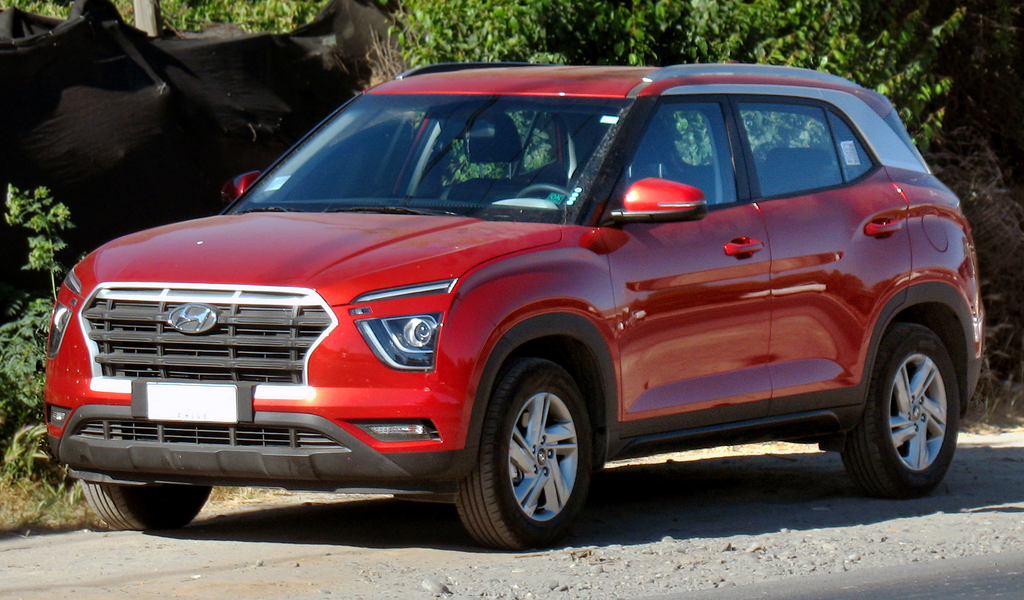
The Creta uses a 1,497 cc naturally aspirated petrol engine producing 113.18 bhp, with a claimed ARAI efficiency of 17.4 kmpl.
Engine and performance
| Specification | Detail |
|---|---|
| Engine | 1,497 cc four-cylinder petrol |
| Power | 113.18 bhp |
| Transmission | 6-speed manual, or CVT on SX CVT |
| Claimed mileage | 17.4 kmpl (ARAI) |
| Fuel tank | 50 litres |
| Drive | Front-wheel drive |
The ARAI figure comes from a laboratory. Nepal is not a laboratory. Nepal is Kalanki at 5:40 pm.
Expect 12–14 kmpl around Kathmandu and 15–16 kmpl on open highway. We use 13 kmpl in the running-cost section below, which is realistic rather than flattering.
Dimensions
| Specification | Detail |
|---|---|
| Length | 4,330 mm |
| Width | 1,790 mm |
| Height | 1,635 mm |
| Wheelbase | 2,610 mm |
| Ground clearance | 190 mm |
| Boot space | 433 litres |
| Kerb weight | 1,590 kg |
| Seating capacity | 5 seats |
The 190 mm ground clearance is the number that matters most in Nepal and gets discussed least. It clears Valley speed breakers, monsoon potholes and the broken stretches of the Prithvi Highway without drama. It does not make the Creta an off-roader, and anyone who tells you otherwise has not driven a Nepali village road in Asar.
At 4,330 mm long the Creta fits comfortably in Kathmandu’s older lanes, and the 2,610 mm wheelbase gives genuinely usable rear legroom three adults for an hour, two adults for a day.
Safety
Six airbags are standard on every variant, including the base E. So are ABS with EBD, electronic stability control, vehicle stability management, hill-start assist and ISOFIX anchors. Higher variants add Hyundai SmartSense Level 2 ADAS adaptive cruise control, lane-keeping assist, autonomous emergency braking plus a 360-degree camera and all-round disc brakes.
Standard six airbags deserves more attention than it gets. Plenty of cars in this price band in Nepal still ration airbags by trim level, so the base buyer gets two and a firm handshake. The base Creta clears a bar that several rivals only reach at the top of their range.
Whether Level 2 ADAS is useful in Nepali traffic is a fair question. Adaptive cruise control on the Mugling road is excellent. Lane-keeping assist in Kathmandu, where lanes are more of a suggestion than a rule, will spend its life mildly confused.
Comfort and technology
Depending on variant: panoramic sunroof, dual-zone automatic climate control, ventilated front seats, eight-way power driver’s seat, wireless charging, USB-C front and rear, electric parking brake with auto hold, smart key with push-button start, 10.25-inch touchscreen with Apple CarPlay and Android Auto.
The ventilated seats are not a showroom gimmick. If your driving includes Biratnagar, Birgunj or Nepalgunj between Baisakh and Bhadau, they are the difference between arriving and merely surviving.
Which Hyundai Creta Variant Should You Buy?
Buy the Creta S at Rs. 62.56 lakh. For most Nepali buyers it is the right answer. Here is the reasoning, plus the three cases where something else wins.
Best overall: Hyundai Creta S — Rs. 62.56 lakh
The Rs. 8 lakh step from E to S is the only point in the range where the money buys a different car rather than a longer feature list. Everything above the S delivers steadily less per rupee. If you are buying one Creta and keeping it, this is where the range peaks.
Best on a tight budget: Hyundai Creta E — Rs. 54.56 lakh
The base car is not a punishment. Same engine, same 190 mm clearance, same 433-litre boot, same six airbags as the Rs. 76.96 lakh version. What you give up is convenience equipment — not safety, not capability.
Anyone stretching uncomfortably to reach the S should take the E without apology and put the difference into the down payment. Nobody has ever looked at a Creta in a car park and thought “ah, but which trim.”
Best for city driving: Hyundai Creta SX CVT — Rs. 76.96 lakh
If your life is Valley traffic, the automatic stops being a luxury and becomes a medical decision. Ring Road at six in the evening, the climb to Bhaktapur, the slow grind through Kalanki a clutch pedal in that environment is a daily tax on your left knee.
Rs. 6.4 lakh for a gearbox is a lot. It is also the single upgrade most likely to change how you feel about the car two years in.
Best fully loaded: Hyundai Creta SX — Rs. 70.56 lakh
Full feature set, ADAS included, manual gearbox retained. For highway drivers who actually enjoy driving and want the technology without the CVT premium.
The one to skip: Hyundai Creta S+
At Rs. 65.96 lakh the S+ sits in the awkward middle. It costs Rs. 3.4 lakh more than the S without adding anything most owners would notice, and for Rs. 4.6 lakh more the SX is a meaningfully better car.
If you find yourself drawn to the S+, you are usually in one of two situations: you should have saved the money and taken the S, or you should stretch and take the SX. The middle of a model range is where value goes to quietly disappear, and the Creta is no exception.
Creta Petrol vs Creta EV — Which Costs Less in Nepal?
The Creta Electric costs less to buy, needs less cash down, and costs dramatically less to run. Over five years and 75,000 km it saves roughly Rs. 12 lakh in fuel, tax and servicing — on top of being Rs. 2.6 lakh cheaper at the showroom.
We ran these numbers twice because the gap looked wrong the first time. It was not wrong.
Purchase price and cash needed
| Model | Ex-showroom Price | On-road Price | Minimum Down Payment | Financing |
|---|---|---|---|---|
| Creta E (Petrol) | Rs. 54.56 lakh | Rs. 56.74 lakh | Rs. 21,82,400 | Up to 60% financing |
| Creta Electric | Rs. 51.96 lakh | Rs. 53.98 lakh | Rs. 10,39,200 | Up to 80% financing |
| EV advantage | Rs. 2.60 lakh lower | Rs. 2.76 lakh lower | Rs. 11.43 lakh less cash required | 20% higher financing eligibility |
There is no break-even point to calculate here, because there is nothing to break even on. The EV starts ahead and stays ahead.
Five-year running cost
Assumptions: 15,000 km a year for five years, real-world 13 kmpl petrol, petrol at Rs. 217 per litre in Kathmandu, home charging at roughly Rs. 12 per unit including charging losses, real-world EV range of 320 km from the 42 kWh battery.
| Cost over 5 Years | Creta E (Petrol) | Creta Electric | EV Savings |
|---|---|---|---|
| Fuel / Electricity | Rs. 12,51,923 | Rs. 1,29,938 | Rs. 11,21,985 |
| Road Tax | Rs. 1,25,000 | Rs. 75,000 | Rs. 50,000 |
| Servicing | Rs. 75,000 | Rs. 40,000 | Rs. 35,000 |
| Total 5-Year Cost | Rs. 14,51,923 | Rs. 2,44,938 | Rs. 12,06,986 |
That is about Rs. 2.41 lakh a year, or roughly Rs. 20,000 a month. For many buyers that is a serious fraction of the EMI itself — the car is, in a real sense, partly paying for itself out of the fuel you are not buying.
The gap opens almost entirely on energy. Nepal imports every drop of petrol and generates its own electricity from water falling downhill. Charge at home overnight and the electric Creta costs roughly one-tenth as much to move the same distance.
Where petrol still wins
The numbers are decisive. The decision is not only numbers.
Long-distance freedom. A claimed 390 km, realistically about 320 km, handles Kathmandu–Pokhara fine. It does not handle a spontaneous decision to drive to Ilam. Nepal’s charging network follows the main highways; step off them and you are planning your day around a socket.
Charging access. Home charging is what makes the economics work. Apartment living without a dedicated parking space and your own meter means relying on public chargers at several times the domestic rate, and the saving shrinks considerably.
Resale uncertainty. Nepal’s used-EV market is young and battery health assessment is not standardised here. Nobody can tell you honestly what a five-year-old Creta Electric will fetch. The petrol car’s resale behaviour is documented see the next section. The EV’s is guesswork.
Supply reliability. Nepal’s electricity supply has improved enormously. “Enormously” is not the same as “everywhere, always.”
For a Kathmandu family with private parking doing school runs, office commutes and the occasional highway trip, the electric Creta is the rational choice by a wide margin. For someone whose work regularly takes them into the hills or the far west, the petrol car remains the sensible one, and the extra Rs. 20,000 a month is what you pay for not thinking about it.
Hyundai Creta Resale Value in Nepal
Used Cretas in Kathmandu are currently asking around 66–77% of the equivalent new price, even after five or more years. That is strong retention by any standard.
Here is what dealers are actually asking, from current Kathmandu listings:
| Year | Variant | Odometer | Asking Price | Vs. Today’s New Equivalent |
|---|---|---|---|---|
| 2021 | Creta E | — | Rs. 42.00 lakh | 77% |
| 2021 | Creta SX MT | 38,000 km | Rs. 50.00 lakh | 71% |
| 2020 | Creta S | 44,000 km | Rs. 46.00 lakh | 74% |
| 2018 | Creta SX(O) 1.6 | 53,000 km | Rs. 46.50 lakh | 66% |
Asking prices from Kathmandu dealer listings, [date]. Asking is not selling — expect negotiation. Retention percentages are against today’s new price for the nearest equivalent variant.
Reading this properly
A 2018 Creta holding 66% of today’s new price sounds extraordinary until you remember what has happened to new-car prices in Nepal. In 2018 the Creta started at Rs. 42.96 lakh. In 2019, Rs. 43.56 lakh. Today the base car is Rs. 54.56 lakh.
So part of that “retention” is not the used car holding its value — it is the new car running away. Rising import costs, currency movement and tax changes lift the whole ladder, and used prices ride up behind them.
The practical consequence is real regardless of the mechanism: Cretas depreciate slowly in Nepal, and you will get more of your money back than you would in most markets. Just do not mistake it for the car being magic. It is mostly the rupee.
Why the Creta holds up
Brand recognition. Everyone knows what a Creta is. A car that needs no explanation is a car that sells quickly.
Service reach. A used car is only worth what someone can afford to maintain, and Hyundai’s network reaches well beyond the Valley.
Steady demand at the price point. The Rs. 40–50 lakh used SUV bracket is exactly where Nepal’s growing middle class shops.
What works against it: high absolute prices mean the rupee depreciation is large even when the percentage looks healthy, and every facelift instantly dates the outgoing model in a buyer’s eyes.
Hyundai Creta vs Kia Seltos vs Mahindra Scorpio N
| Specification | Hyundai Creta | Kia Seltos | Mahindra Scorpio N |
|---|---|---|---|
| Starting price | Rs. 54.56 lakh | Rs. 52.90 lakh | Rs. 90.00 lakh |
| Top variant price | Rs. 76.96 lakh | Rs. 82.90 lakh | Rs. 1.24 crore |
| Engine | 1,497 cc petrol | 1,482 cc petrol / diesel | Diesel |
| Power | 113.18 bhp | 113 bhp | — |
| Ground clearance | 190 mm | 155 mm | — |
| Length | 4,330 mm | 4,368 mm | — |
| Wheelbase | 2,610 mm | 2,690 mm | — |
| Boot space | 433 litres | — | — |
| Seating capacity | 5 | 5 | 5 or 7 |
| Airbags | 6 standard | 6 | — |
| Distributor | Laxmi Intercontinental | Kia Nepal | Agni Group |
| Variants in Nepal | 5 petrol + 1 EV | 7 | 3 |
What the table does not say
The Creta and Seltos are cousins. Same platform family, near-identical engines, similar output. The Seltos undercuts the Creta by Rs. 1.66 lakh at entry and out-tops it at Rs. 82.90 lakh, and it comes in seven variants against the Creta’s five.
The number worth staring at is ground clearance. 190 mm against 155 mm — a 35 mm gap that means very little on a spec sheet and quite a lot on a Nepali road in monsoon. If your driving includes anything unpaved, that single figure may settle the argument on its own.
Otherwise the choice usually comes down to styling preference and which dealer network you trust for service, which is a more sensible basis for a decision than most people admit.
The Scorpio N is not really a rival. It starts at Rs. 90 lakh — Rs. 35 lakh above the base Creta, and above the fully-loaded SX CVT. It is a bigger, more rugged, diesel proposition with seven seats available.
If your shortlist genuinely contains both a Rs. 54 lakh Creta and a Rs. 90 lakh Scorpio N, you are not comparing cars. You are still deciding what kind of driver you are, and that is a conversation to have before the showroom, not in it.
Where to Buy the Hyundai Creta in Nepal
Laxmi Intercontinental is the sole authorised Hyundai distributor in Nepal, and now assembles the Creta locally. Every new Creta with factory warranty comes through their network.
The buying sequence
- Test drive the variant you actually intend to buy. Not a different one. The CVT and manual are meaningfully different cars, and “similar” is doing a lot of work in that sentence.
- Ask whether the unit is assembled in Nepal or imported. They are priced differently.
- Get the full out-the-door quote in writing, itemised. Ex-showroom, registration, insurance, accessories, dealer handling each on its own line. A single lump figure is where surprises live.
- Ask what offers are running. Cash discounts and exchange bonuses are rarely volunteered to someone who seems ready to sign.
- Compare at least three banks. Rates differ, and remember the 60% financing cap on petrol.
- Confirm the waiting period in writing, including for your colour. Popular combinations take longer.
- Inspect at delivery in daylight. VIN, odometer reading, accessory list against invoice, every panel. Ten minutes now against years of mild irritation later.
Documents to bring: citizenship certificate, PAN card, passport photographs, proof of address, and if financing — whatever income documentation your bank specifies. Bring a PAN regardless if the loan exceeds Rs. 25 lakh; it is mandatory.
Servicing and Running Costs
Service intervals typically fall at 10,000 km or twelve months, whichever comes first.
Budget roughly Rs. 15,000 a year for routine servicing on the petrol Creta. The electric version costs materially less — no oil, no filters, and regenerative braking means the brake pads live long, uneventful lives.
Beyond scheduled servicing, plan for tyres every 40,000–50,000 km, brake pads, the 12V battery and wiper blades. And know that on Nepali roads, suspension components wear faster than any manufacturer schedule assumes. Manufacturer schedules are written by people who have never met the road to Nagarkot.
Hyundai’s service network reach matters more than buyers realise at purchase time. It affects your downtime, your parts availability, and — as the resale section showed — what someone will pay you for the car in five years.
[Verify current service costs and intervals with Laxmi Intercontinental’s service department.]
Nepali car Nepal first trusted Car News, Reviews, Prices & Information.
From idea2grow